Why CRM and Marketing Tools Cost SMBs More Than They Should | Catalyst
Why CRM and Marketing Tools Cost SMBs More Than They Should
Small and mid-sized businesses rarely set out to overspend on software. Most decisions are made with good intentions — trying to grow faster, respond better, or look more professional.
Yet over time, many SMBs find themselves paying more than they expected for CRM and marketing tools, without feeling more in control of their business.
The issue usually isn’t one bad purchase. It’s how tools quietly stack up as the business grows.
How Tool Costs Add Up Without You Noticing
In the early stages, adding a new tool feels harmless. A form builder here. An email platform there. A CRM to “organize things later.” A texting tool to respond faster.
Each solves a real problem.
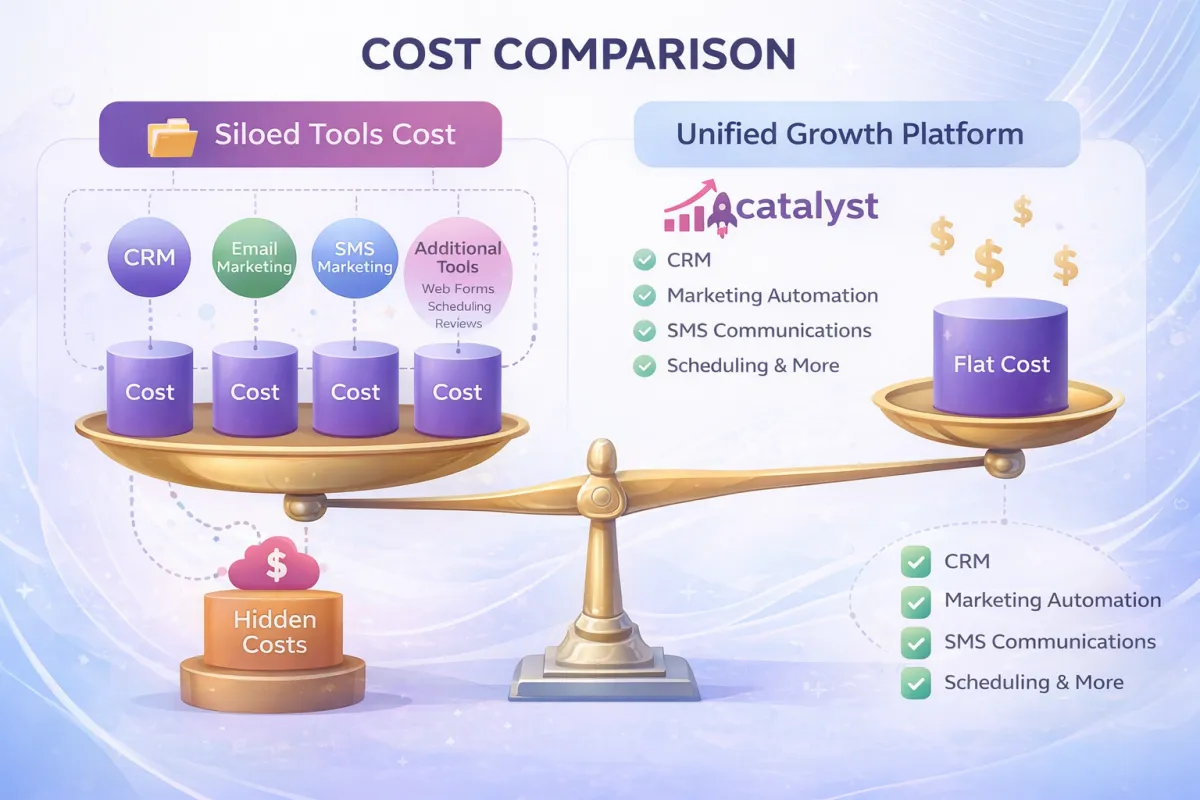
But as the business scales, those tools start overlapping. Data lives in different places. Teams log into multiple dashboards. Information gets copied, missed, or forgotten.
What once felt affordable now feels heavy — not just financially, but operationally.
The Hidden Cost Isn’t Just the Subscription Fee
Most SMBs evaluate tools based on monthly pricing. What often goes unmeasured is the total cost of ownership.
That includes:
Time spent switching between platforms
Training staff on multiple systems
Missed follow-ups due to disconnected tools
Features paid for but rarely used
Difficulty tracking what actually drives revenue
These costs don’t show up on an invoice, but they quietly slow growth.
Why SMBs End Up Overpaying Compared to Larger Companies
Ironically, smaller businesses often pay more per outcome than larger ones.
Enterprise teams spread costs across departments, negotiate pricing, and dedicate staff to managing systems. SMBs don’t have that luxury. Owners and small teams absorb the overhead themselves.
When tools aren’t unified, every new hire or marketing push adds complexity instead of leverage.
This is why many SMBs feel like they’re “busy all the time” but not moving forward as quickly as they should.
More Tools Don’t Equal Better Systems
A common misconception is that growth requires more software.
In reality, growth requires better coordination.
When systems don’t talk to each other, businesses compensate manually — checking messages, reminding teammates, chasing updates. That manual effort becomes a hidden tax on growth.
At a certain point, the cost of fragmentation outweighs the benefit of specialized tools.
What Cost-Conscious Scaling Actually Looks Like
Cost-conscious scaling doesn’t mean choosing the cheapest tools. It means choosing tools that reduce friction.
Businesses that scale sustainably tend to:
Centralize customer conversations
Automate routine follow-ups
Reduce duplicate data entry
Gain visibility into lead and revenue flow
Spend less time managing software and more time serving customers
Some turn to unified growth platforms like Catalyst not because they want fewer tools, but because they want fewer gaps — financially and operationally.
When Software Starts Supporting Growth Instead of Draining It
When CRM and marketing systems are connected, costs become easier to justify. Teams move faster. Owners see what’s working. Decisions are based on data instead of assumptions.
The result isn’t just lower spend — it’s better use of time, energy, and attention.
For SMBs, that clarity is often the biggest return on investment.
Cost Isn’t the Enemy — Complexity Is
Most small businesses don’t fail because they invest too much in software. They struggle because complexity grows faster than their systems.
Solving the cost issue starts with simplifying how tools work together — not adding more of them.
Want to understand what your tools are really costing you?
A short Catalyst growth walkthrough can help identify where spend, effort, and opportunity are misaligned — without pressure or commitment.
